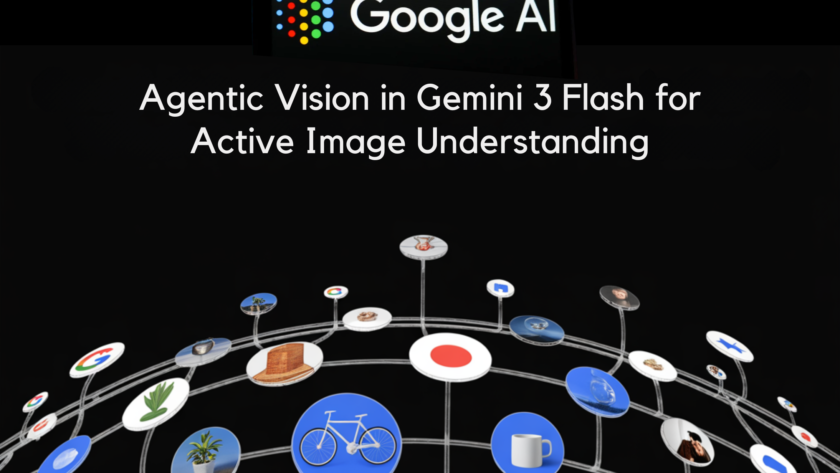
Frontier multimodal models usually process an image in a single pass. If they miss a serial number on a chip or a small symbol on a building plan, they often guess. Google’s new Agentic Vision capability in Gemini 3 Flash changes this by turning image understanding into an active, tool using loop grounded in visual…
In August, we previewed Genie 3, a general-purpose world model capable of generating diverse, interactive environments. Even in this early form, trusted testers were able to create an impressive range of fascinating worlds and experiences, and uncovered entirely new ways to use it. The next step is to broaden access through a dedicated, interactive prototype…
How do you build a single vision language action model that can control many different dual arm robots in the real world? LingBot-VLA is Ant Group Robbyant’s new Vision Language Action foundation model that targets practical robot manipulation in the real world. It is trained on about 20,000 hours of teleoperated bimanual data collected from 9…
When Algorithms Dream of Photons: Can AI Redefine Reality Like Einstein? | by Manik Soni | Jan, 2025
In 1905, Albert Einstein published a paper on the photoelectric effect — a deceptively simple observation that light could eject electrons from metals. This work, which later won him the Nobel Prize, didn’t just explain an oddity in physics. It shattered classical mechanics, birthing quantum theory and reshaping our understanding of reality. But here’s a…
This AI Paper Introduces MAETok: A Masked Autoencoder-Based Tokenizer for Efficient Diffusion Models
Diffusion models generate images by progressively refining noise into structured representations. However, the computational cost associated with these models remains a key challenge, particularly when operating directly on high-dimensional pixel data. Researchers have been investigating ways to optimize latent space representations to improve efficiency without compromising image quality.
A critical problem in diffusion models is…
In December, we kicked off the agentic era by releasing an experimental version of Gemini 2.0 Flash — our highly efficient workhorse model for developers with low latency and enhanced performance. Earlier this year, we updated 2.0 Flash Thinking Experimental in Google AI Studio, which improved its performance by combining Flash’s speed with the ability…
Robots are usually unsuitable for altering different tasks and environments. General-purpose models of robots are devised to circumvent this problem. They allow fine-tuning these general-purpose models for a wide scope of robotic tasks. However, it is challenging to maintain the consistency of shared open resources across various platforms. Success in real-world environments is far from…
Which Outcome Matters? Here is a common scenario : An A/B test was conducted, where a random sample of units (e.g. customers) were selected for a campaign and they received Treatment A. Another sample was selected to receive Treatment B. “A” could be a communication or offer and “B” could be no communication or no…
OpenAI, Sam Altman, Elon Musk, xAI, Anthropic, Gemini, Google, Apple… all these companies are racing to build AGI by 2025, and once achieved, it will be replicated by dozens of others within weeks. The idea of creating a compressed knowledge base of humanity, extracting information, and iterating on outputs to optimize results is no longer…
Despite progress in AI-driven human animation, existing models often face limitations in motion realism, adaptability, and scalability. Many models struggle to generate fluid body movements and rely on filtered training datasets, restricting their ability to handle varied scenarios. Facial animation has seen improvements, but full-body animations remain challenging due to inconsistencies in gesture accuracy and…