# Introduction
Visualize this: a multi-agent workflow that reads files, writes patches, runs tests, and iterates across four services, making 400 API calls in a single afternoon. The notification arrives. You have crossed the soft limit again. Every token costs money, every prompt sends your proprietary code to a third-party server, and the…
Why diffusion for text? While the AI research community has explored diffusion-based text generation for years, applying it to large models has remained a challenge. DiffusionGemma changes this by shifting how models use hardware. The trade-off with traditional models Most language models act like a typewriter, generating one token at a time from left to…
# Introduction
A model that says it is 90% confident should be right 90% of the time. When that relationship breaks down, you get a miscalibration problem. The model's scores stop telling you anything useful about reliability.
For large language models (LLMs), miscalibration is widespread. A 2024 NAACL survey found that confidence scores…
In this tutorial, we work through an end-to-end workflow for Qualcomm AI Hub Models. We start by setting up the required package, discovering the available model collection, and loading MobileNet-V2 for local PyTorch inference. We also handle an important input-shape issue by converting NHWC image tensors into the NCHW format expected by the model. From…
For centuries, the scientific method has been the greatest engine of human progress. At Google, our mission is deeply rooted in building tools to accelerate it. We believe that a new era of discovery won’t come from narrow, specialized models, but general agents that empower researchers across every scientific field. That’s why we are introducing…
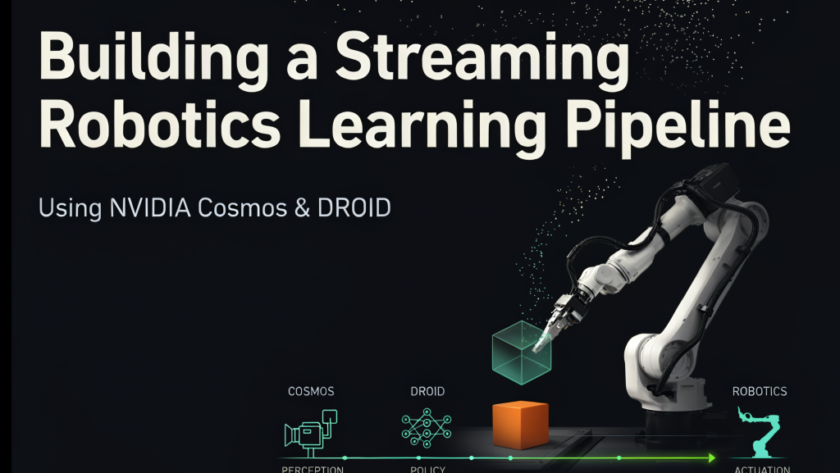
NVIDIA AI team have released Cosmos 3. It is a family of omnimodal world models for physical AI. The models combine physical reasoning, world generation, and action generation. All three capabilities live inside one open model. NVIDIA open sourced the checkpoints, training scripts, deployment tools, and datasets. The Cosmos 3 release targets robotics, autonomous vehicles,…
# Introduction
For a long time, running transformer models meant maintaining a Python server, paying for GPU time, and routing every inference request through an API. The user typed something, it left their machine, touched your infrastructure, and came back as a prediction. That architecture made sense when the models were too large…
Last year, Nano Banana brought Gemini's intelligence to image generation and editing. Since then, it’s helped millions of people restore old photos, design from sketches and visualize ideas in ways that weren’t possible before. From the start we built Gemini to be natively multimodal from the ground up, and now we’re taking the next step.…
Genesis AI released Genesis World 1.0. The platform consists of four components: the Genesis World physics engine, Nyx (a real-time path-traced renderer), Quadrants (a Python-to-GPU compiler), and a simulation interface. It is designed to accelerate robotics foundation model development through simulation-based evaluation.
Robotics model development has two bottlenecks: data and iteration speed. The field has…
# Introduction
Training a machine learning model and observing the loss decrease is a feeling of progress, until the validation accuracy reaches a plateau or the loss begins to spike, and you're not sure what caused it. At that point, most people add more logging or start tuning hyperparameters, hoping something changes. What…