A first-year investment banking analyst at a bulge bracket bank in the US costs $170k–$190k all-in. They spend most of their first year formatting pitch books, building the same DCF they built last month, reconciling accounts that will need reconciling again in 30 days, and writing variance commentary that explains the past to people who already lived through it.
The ratio of judgment to repetition skews heavily toward repetition, and that ratio has not changed in decades. In 2026 it is starting to change.
AI is not smart enough to replace financial judgement (yet). But for the repetitive half of the job: the formatting, the first drafts, the matching, the narrating, AI is now fast, accurate and integrated enough to be genuinely useful on the same afternoon you set it up.
In this article, we’ll look at four practical finance workflows where Claude already shows strong promise today: investment banking materials, financial modeling support, month-end reconciliation, and variance analysis. We’ll also look at where it still needs human review before anyone should trust it in a serious workflow.
How Finance Teams Use Claude for Investment Banking Work
Investment banking runs on documents. CIMs, teasers, process letters, buyer lists, merger models, pitch decks. The work is real and repetitive: an analyst building a one-pager for a deal teaser spends hours formatting, sourcing data, and structuring the same four quadrants they built last week for a different company.
Anthropic released a dedicated Investment Banking plugin for Claude Cowork on February 24, 2026. It is open source, free to install, and gives Claude 7 slash commands backed by 9 underlying skills across three workflow categories: deal materials, presentations, and transaction support. Quick terminology note since it comes up throughout this guide: skills are the domain knowledge modules that activate automatically when relevant; commands are the slash commands you invoke explicitly. Each command calls one or more underlying skills.
What it contains
Deal materials: CIM drafting, teaser generation, process letters, buyer lists, and data pack extraction from existing documents. Presentations: strip profiles and pitch deck population using your firm’s branded PowerPoint templates. Transaction support: merger model construction and a deal tracker for live milestones and action items.
Installing it
The plugin requires Claude Cowork (desktop app, Enterprise plan or above) or Claude Code (Pro Plan or above.) Install the financial-analysis core plugin first, it provides the shared modeling tools and all MCP data connectors that the IB plugin depends on. Then add investment-banking on top.
Via Claude Code:
claude plugin marketplace add anthropics/financial-services-plugins
claude plugin install financial-analysis@financial-services-plugins
claude plugin install investment-banking@financial-services-plugins
Via Cowork desktop: Settings → Plugins → Add marketplace from GitHub → enter https://github.com/anthropics/financial-services-plugins → install financial-analysis, then investment-banking.
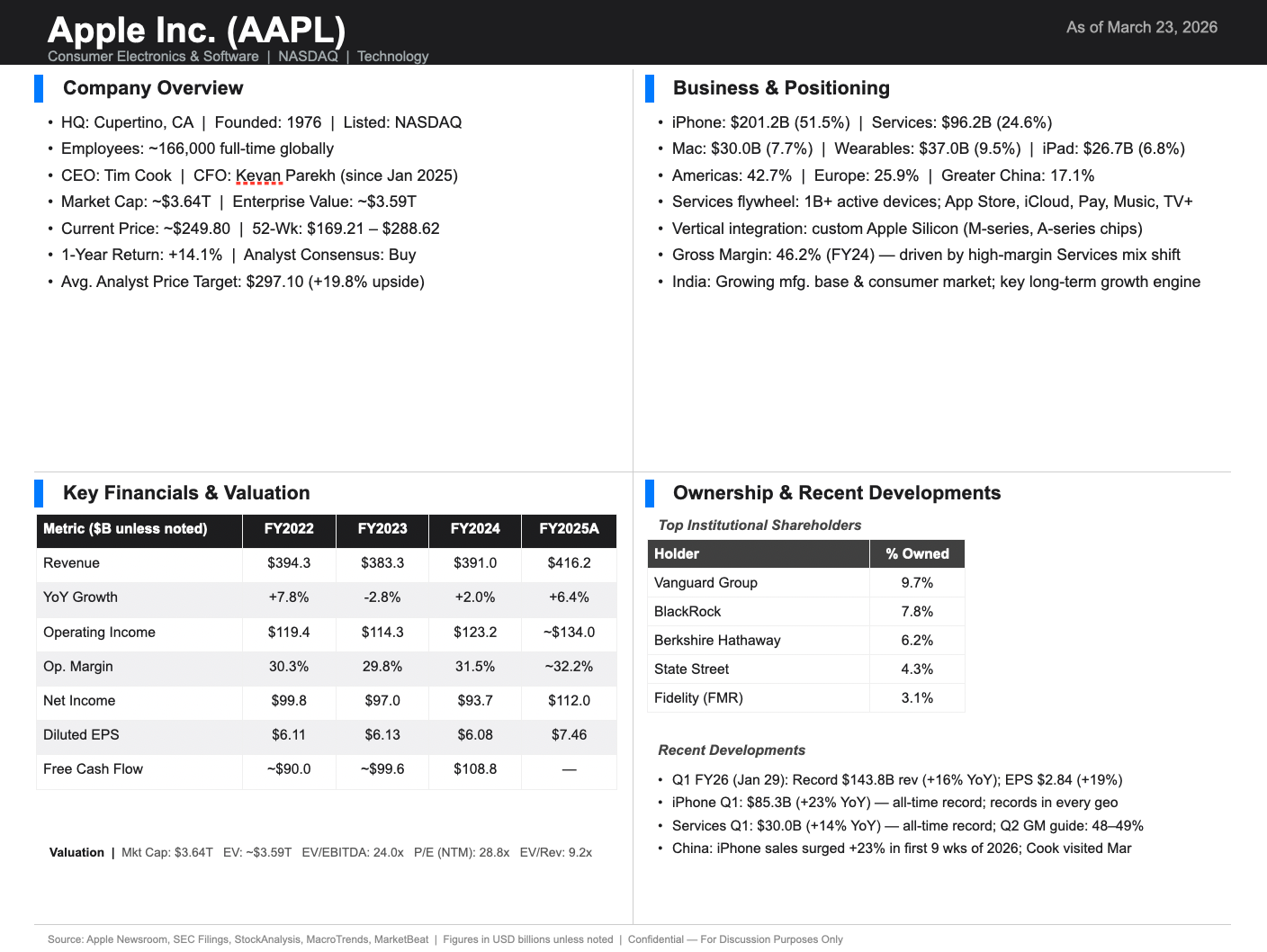
/one-pager [Company Name] Generates a single PowerPoint slide with four quadrants: Overview, Business, Financials, and Ownership. Respects your existing template’s margins and branding. This is the strip profile that populates pitch books and buyer lists.
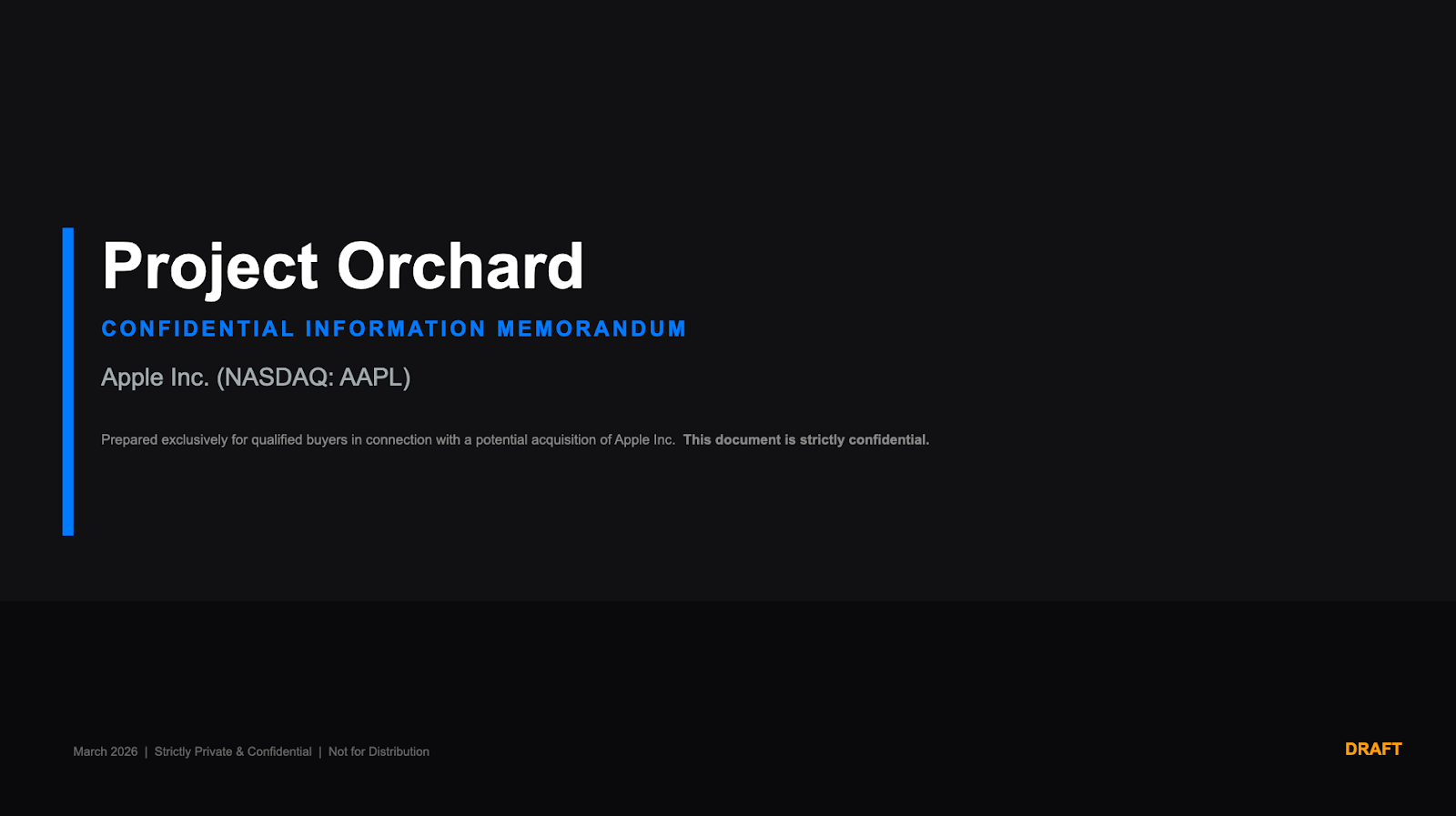
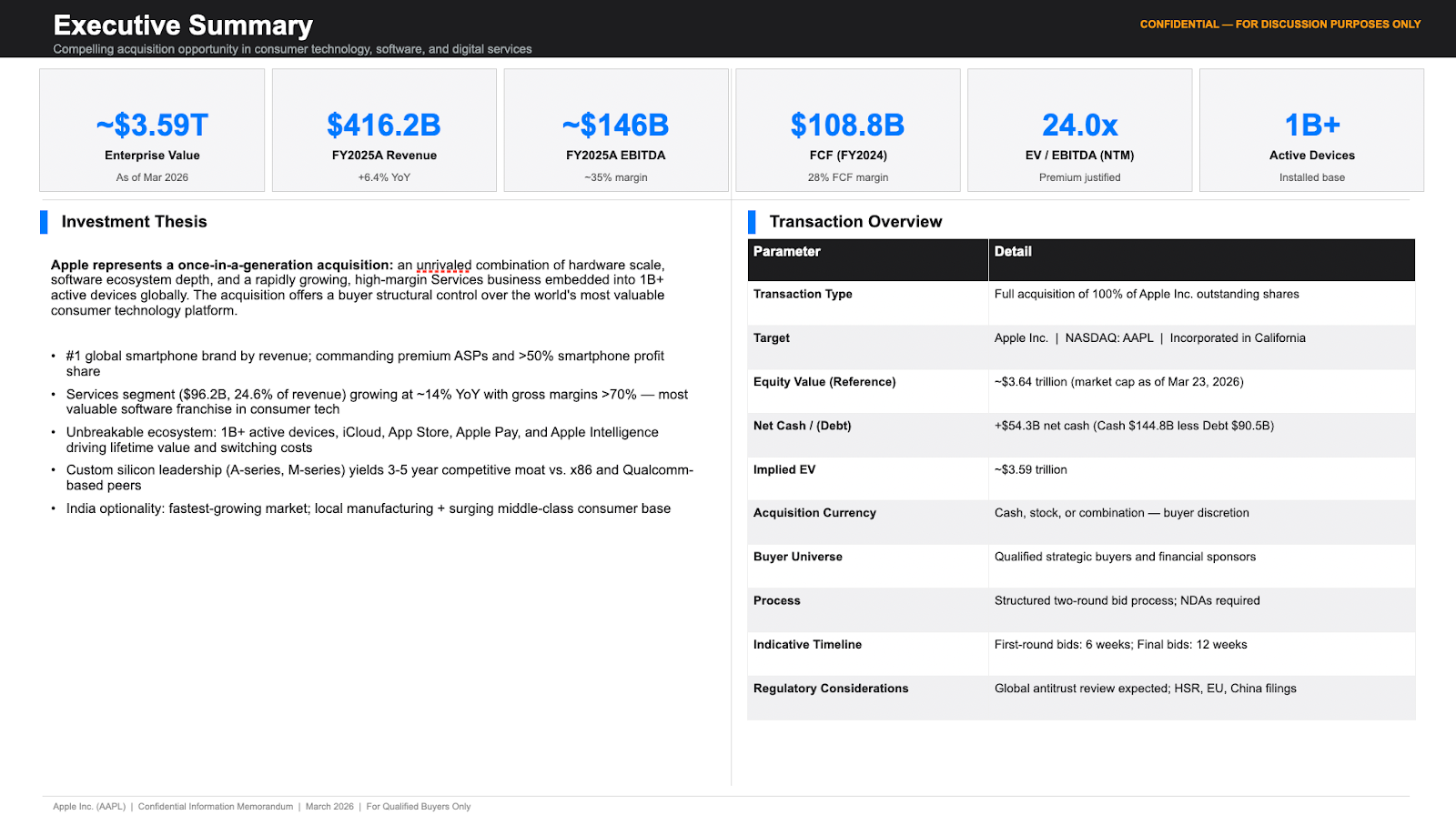
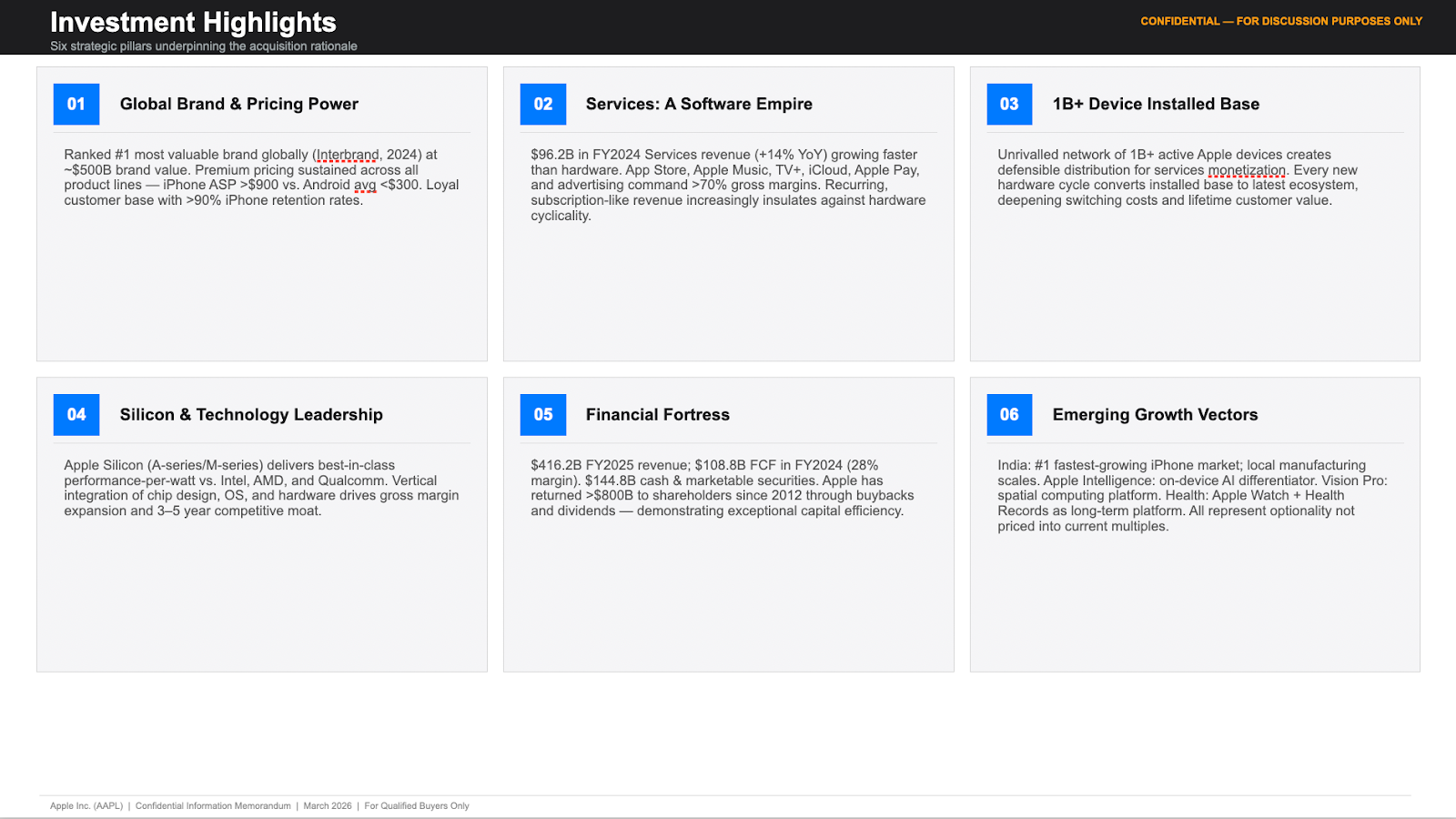
/cim [Company Name] Produces a full Confidential Information Memorandum: executive summary, business overview, financial analysis, and market positioning sections. Claude drafts the structure and content; your team fills in proprietary data and tightens the narrative.
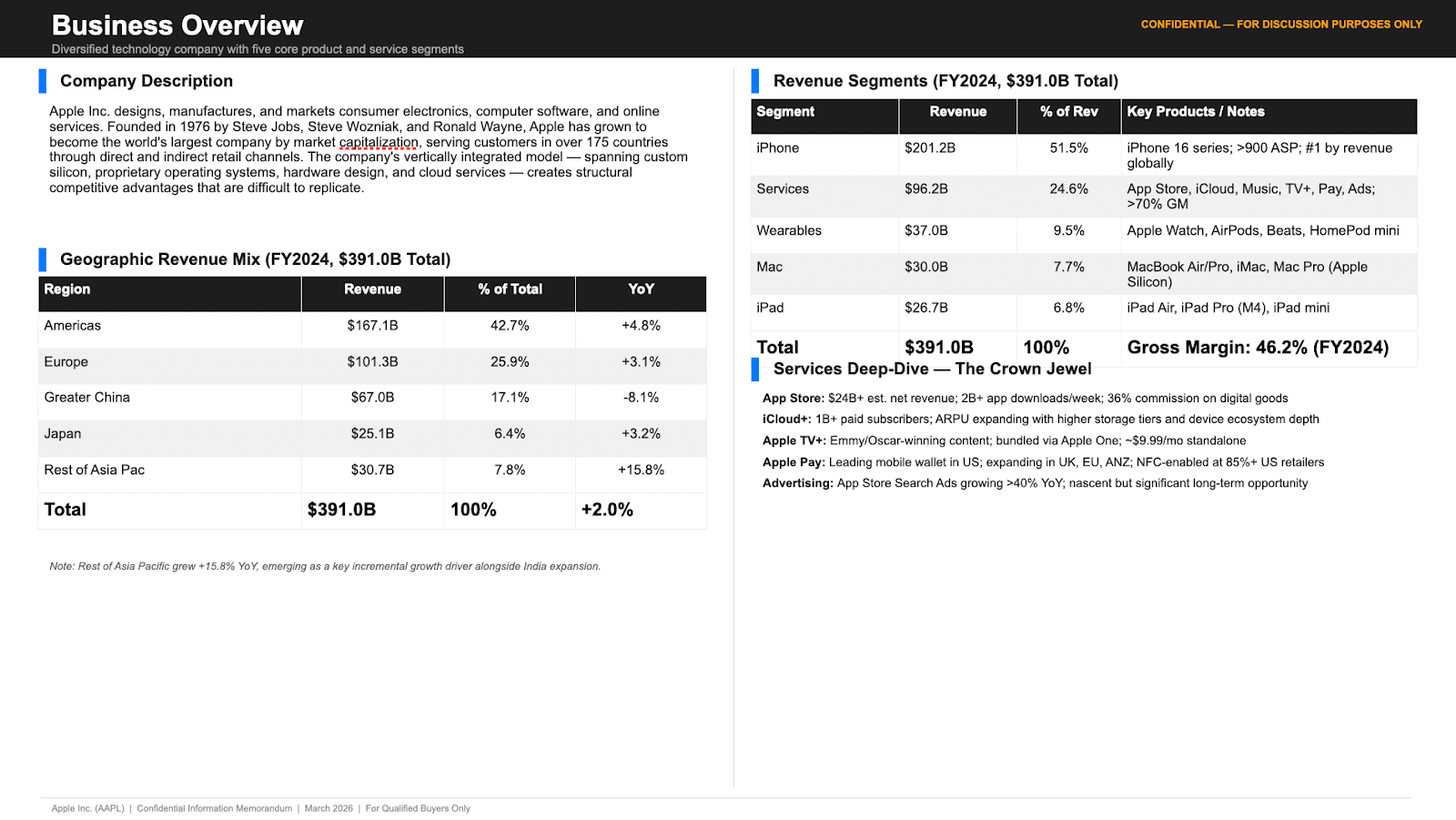
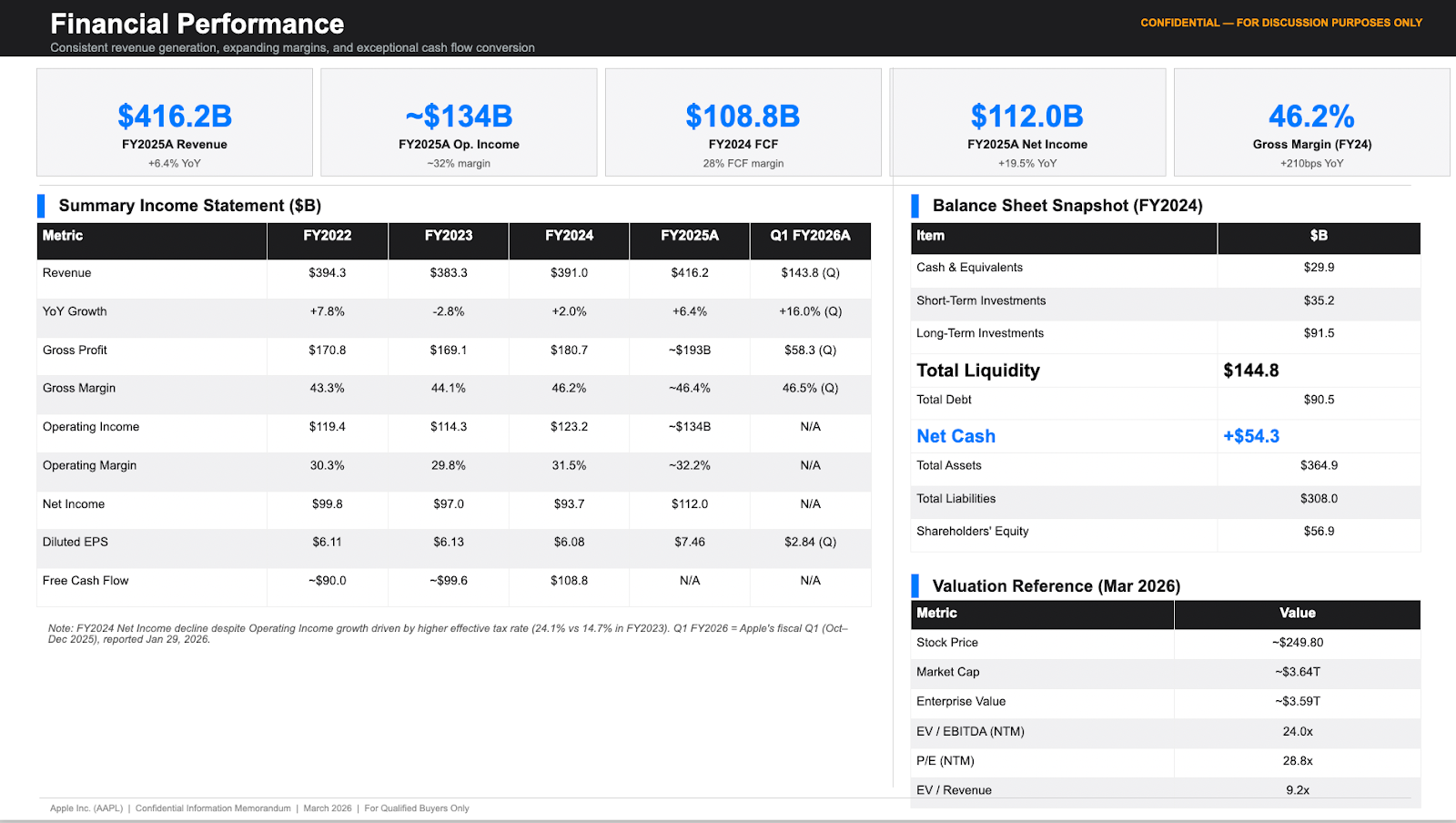
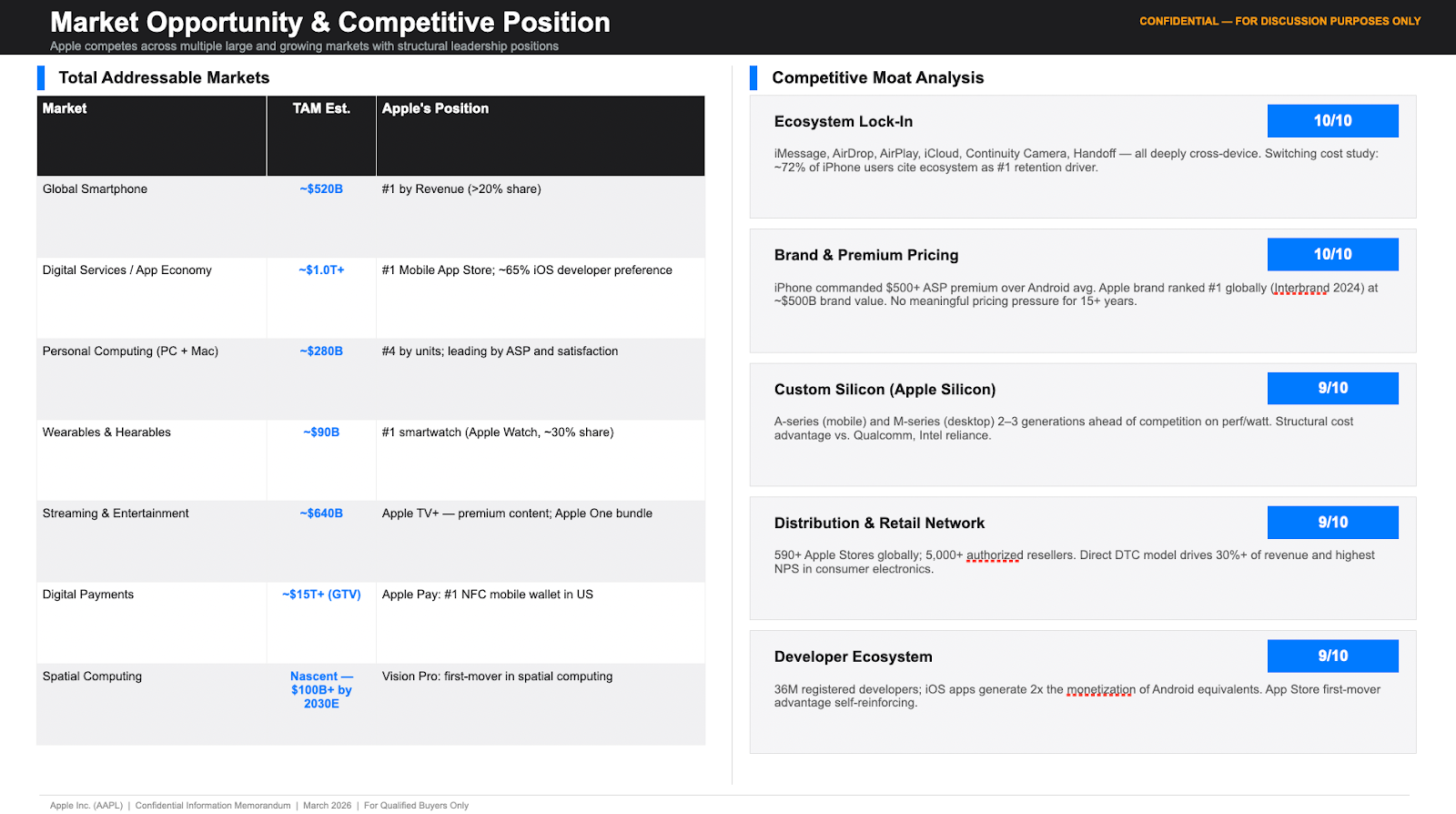
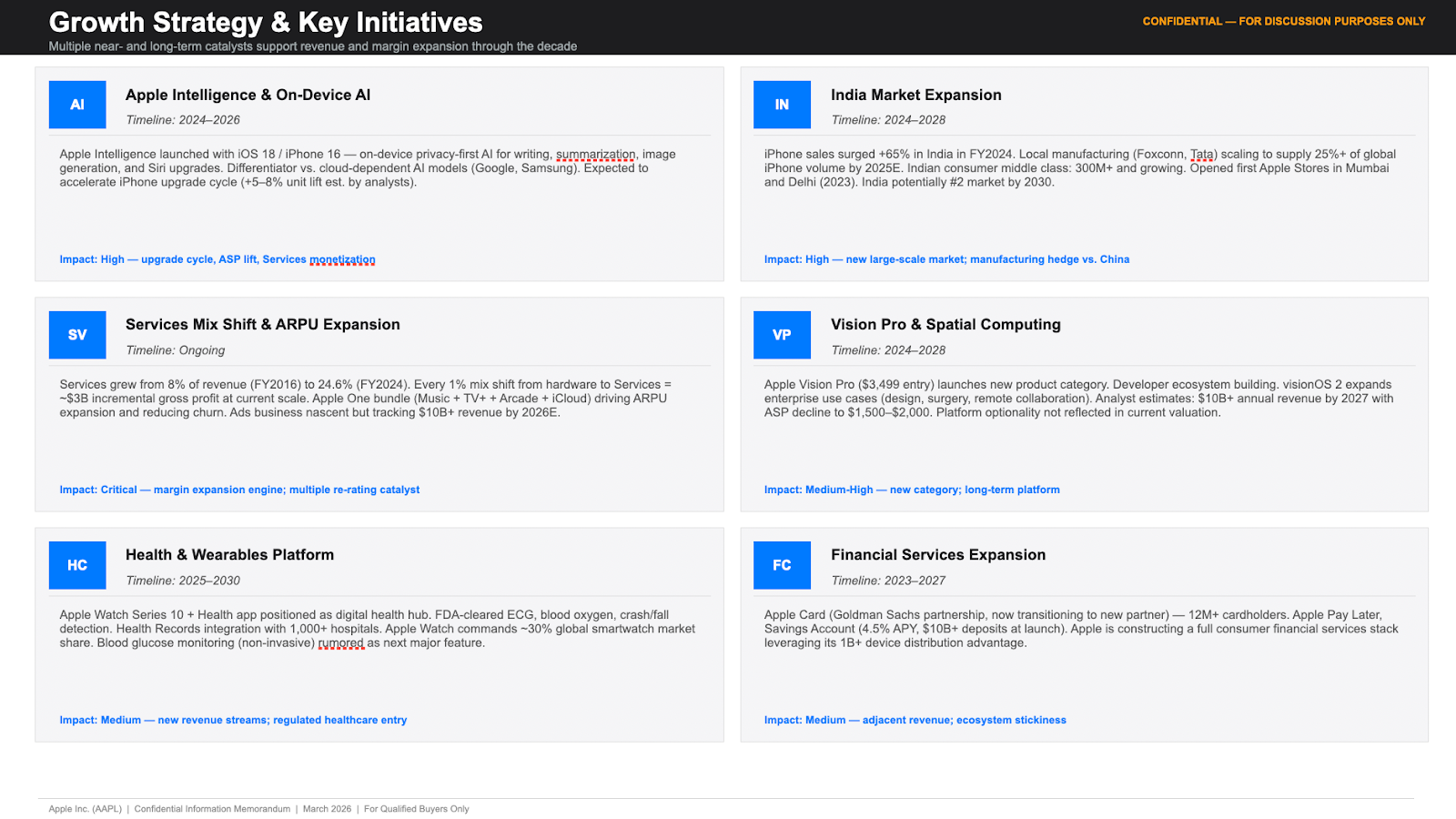
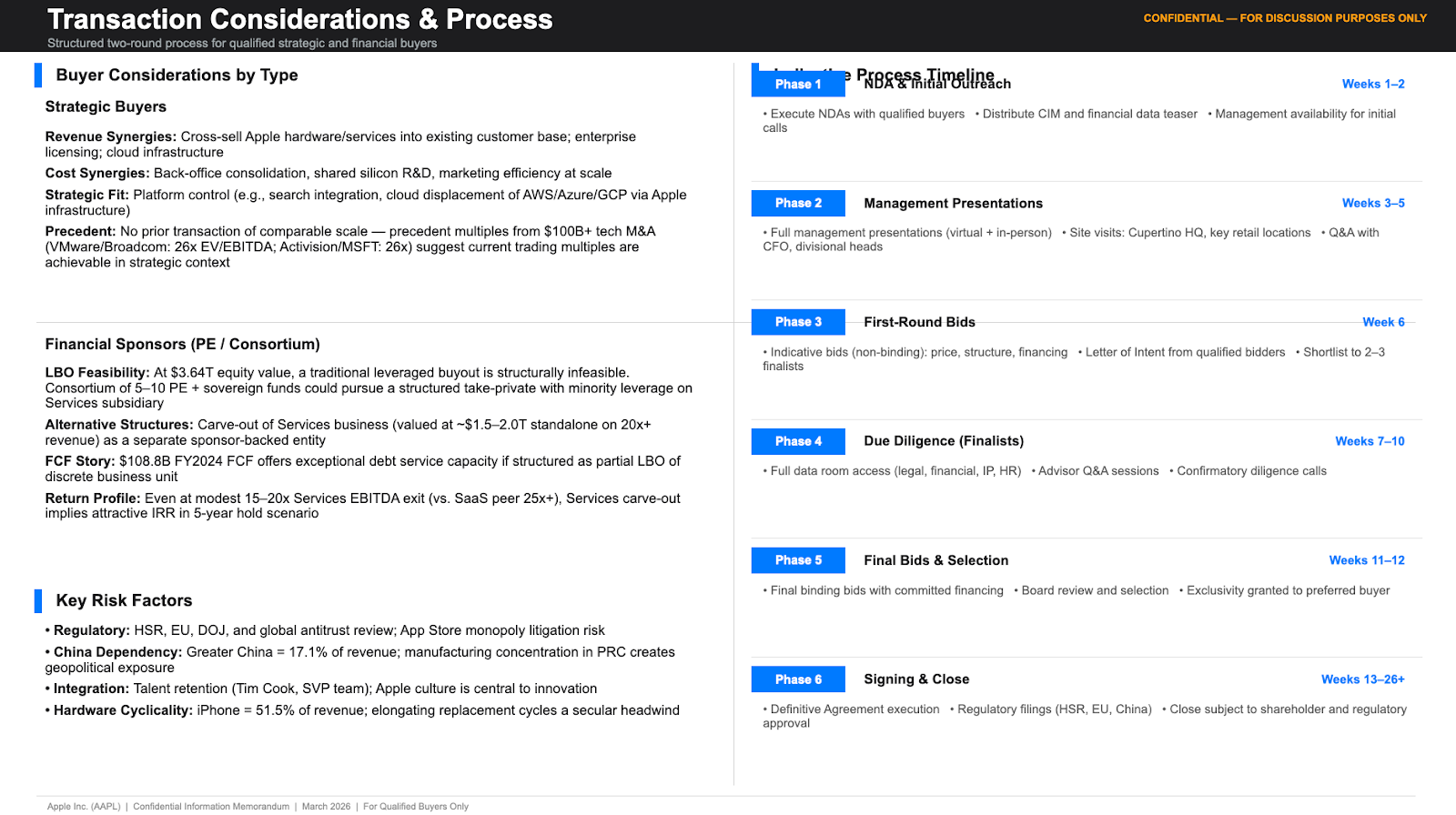
Rest of the commands for you to try yourself:
/teaser [Company Name] Generates an anonymous one-page company teaser for early-stage deal marketing. Same core structure as the CIM but stripped of identifying information.
/buyer-list [Company Name] Assembles a strategic and financial buyer universe. Claude categorizes potential acquirers by type, sizes the fit, and structures the output for easy review and prioritization.
/merger-model [Acquirer acquiring Target] Builds an accretion/dilution M&A analysis. Output includes sources and uses schedule, pro forma financials, and sensitivity analysis on purchase price and synergies.
/process-letter [Deal Description] Produces bid instructions and process correspondence for a live transaction.
/deal-tracker Tracks active deals, milestones, and action items. A structured project management view for live mandates.
How to get the most out of it
The plugin ships with generic methodology. The real value comes when you customize the skill files for your firm: drop in your terminology, reference your branded PowerPoint template in the skill files, adjust the CIM structure to your house format. After that, every CIM draft, every one-pager, every buyer list comes out in your voice.
Claude carries full context between Excel and PowerPoint in a single session. An analyst can run /merger-model, update assumptions in Excel, then ask Claude to build the summary slide in PowerPoint without switching tools or losing context. This cross-app workflow is in research preview for paid plans as of February 2026.
Honest caveat
These commands produce first drafts, not final deliverables. The CIM needs your firm’s proprietary market intelligence. The buyer list needs your banker’s network knowledge. The merger model needs human verification of every assumption before it goes to a client. Use these as the starting point, not the finished product.
Using Claude for Comparable Company Analysis, DCF Models and Valuation Outputs
Raw prompting while building financial models produces output that looks correct and is not. An analyst at a financial modeling consultancy ran this test in January 2026: same prompt to Claude for Excel and Excel’s Agent Mode. Claude’s model had a cleaner layout and better styling. It also discounted cash flows using a debt-to-equity ratio instead of WACC, set the equity risk premium at 120% instead of 5-6%, and used a different discounting method for the terminal value. It looked investment-committee-ready and was arithmetically broken.
That failure mode has a fix, and it is the financial-analysis plugin.
Installing it
The financial-analysis plugin is also the foundation for the IB plugin from section. If you installed that already, you have this too. If not:
claude plugin marketplace add anthropics/financial-services-plugins
claude plugin install financial-analysis@financial-services-plugins
Once active, you get two commands plus MCP connectors to every major financial data provider.
/comps [Company Name]
Runs a comparable company analysis. Claude selects the peer group, pulls current trading multiples from connected data sources, builds the comps table, and outputs a formatted Excel workbook with industry-standard structure. The peer selection is the one thing you review and adjust – that judgment cannot be automated. Everything else: pulled, calculated, formatted.
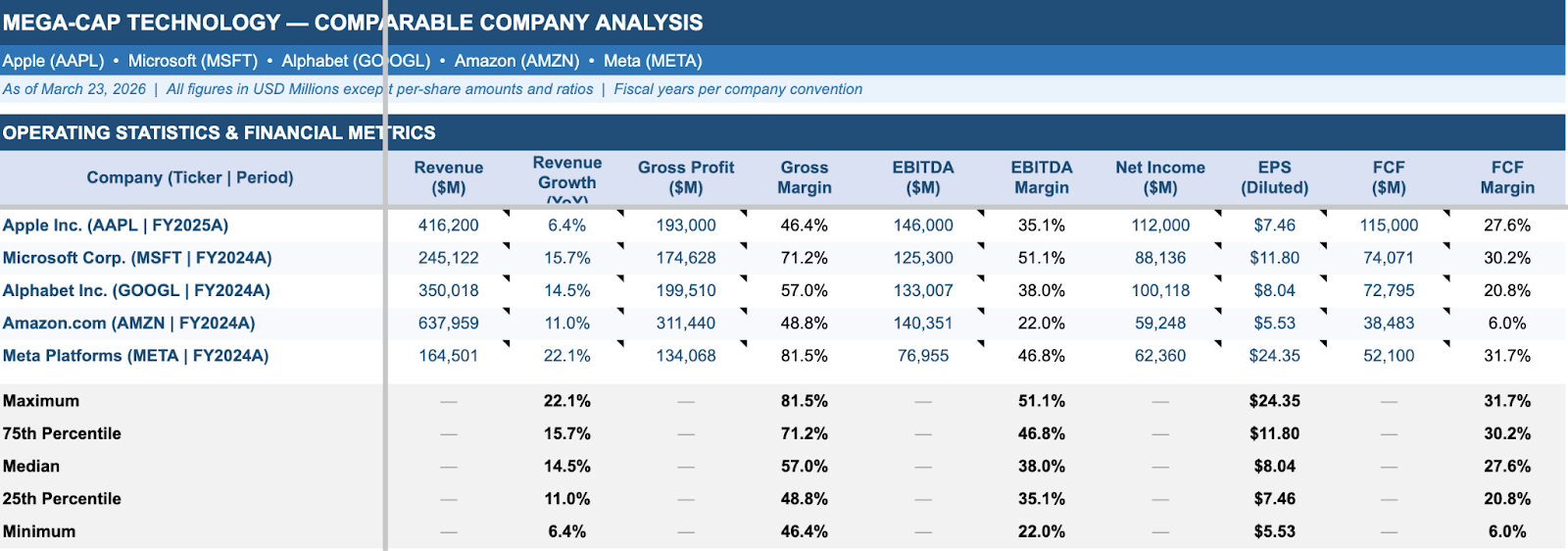
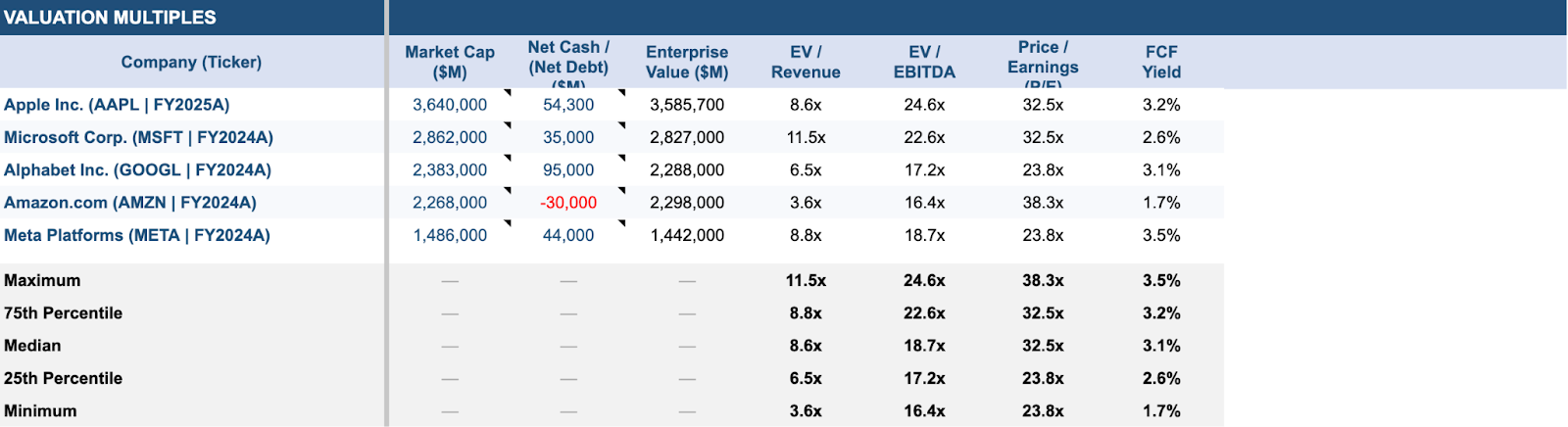
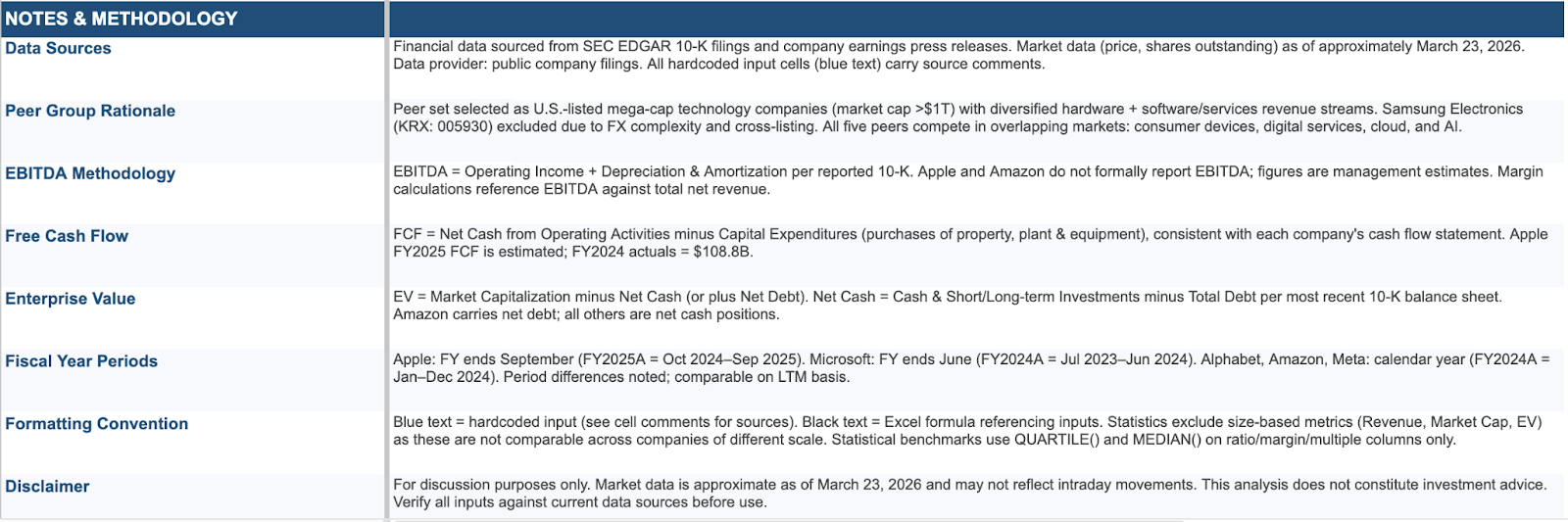
/dcf [Company Name]
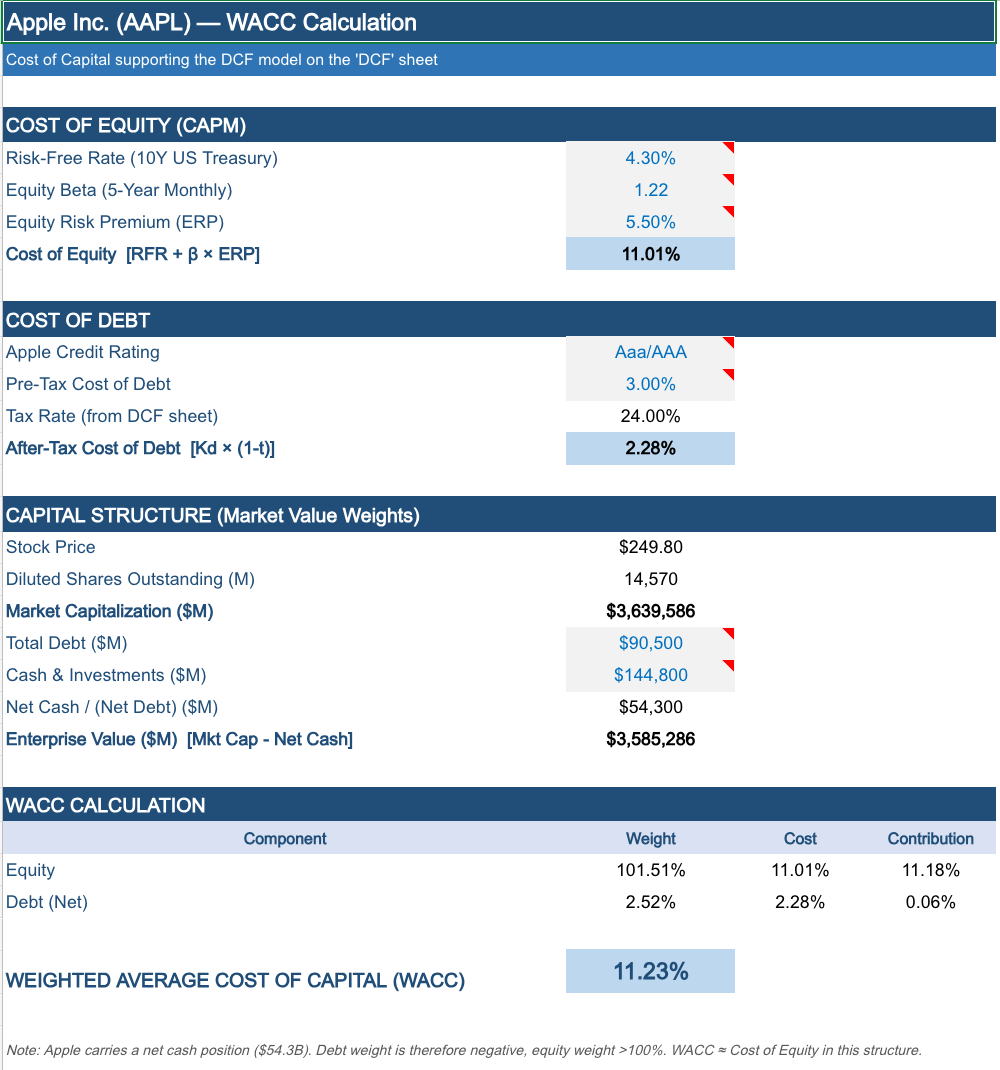
Builds a full DCF. The plugin’s methodology layer is what makes this different from a raw prompt: it pulls the current government yield curve from LSEG to set the risk-free rate, retrieves historical equity prices and beta to anchor the cost of equity, and checks for internal consistency before outputting. The inputs are market-driven and traceable, not assumed.
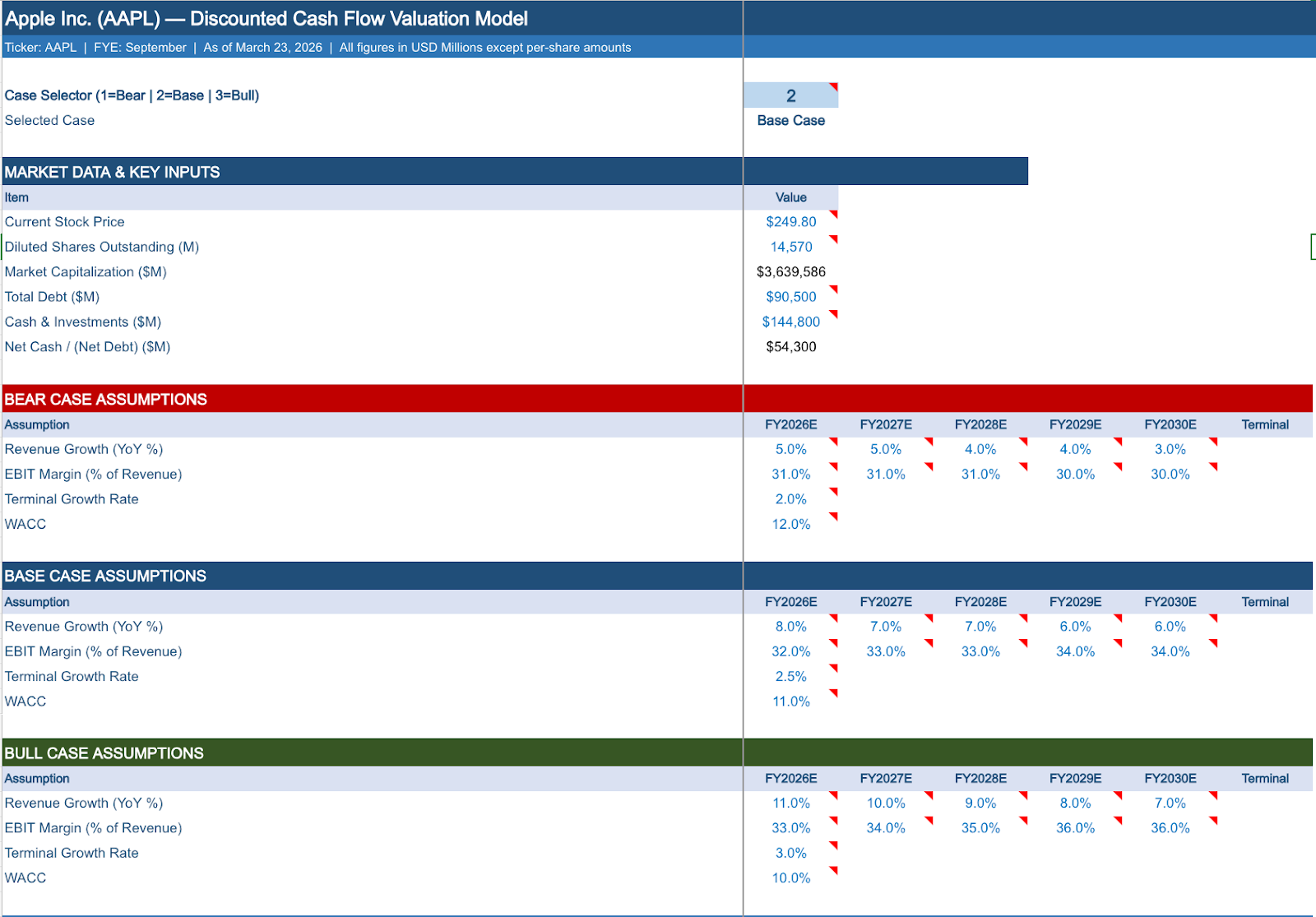
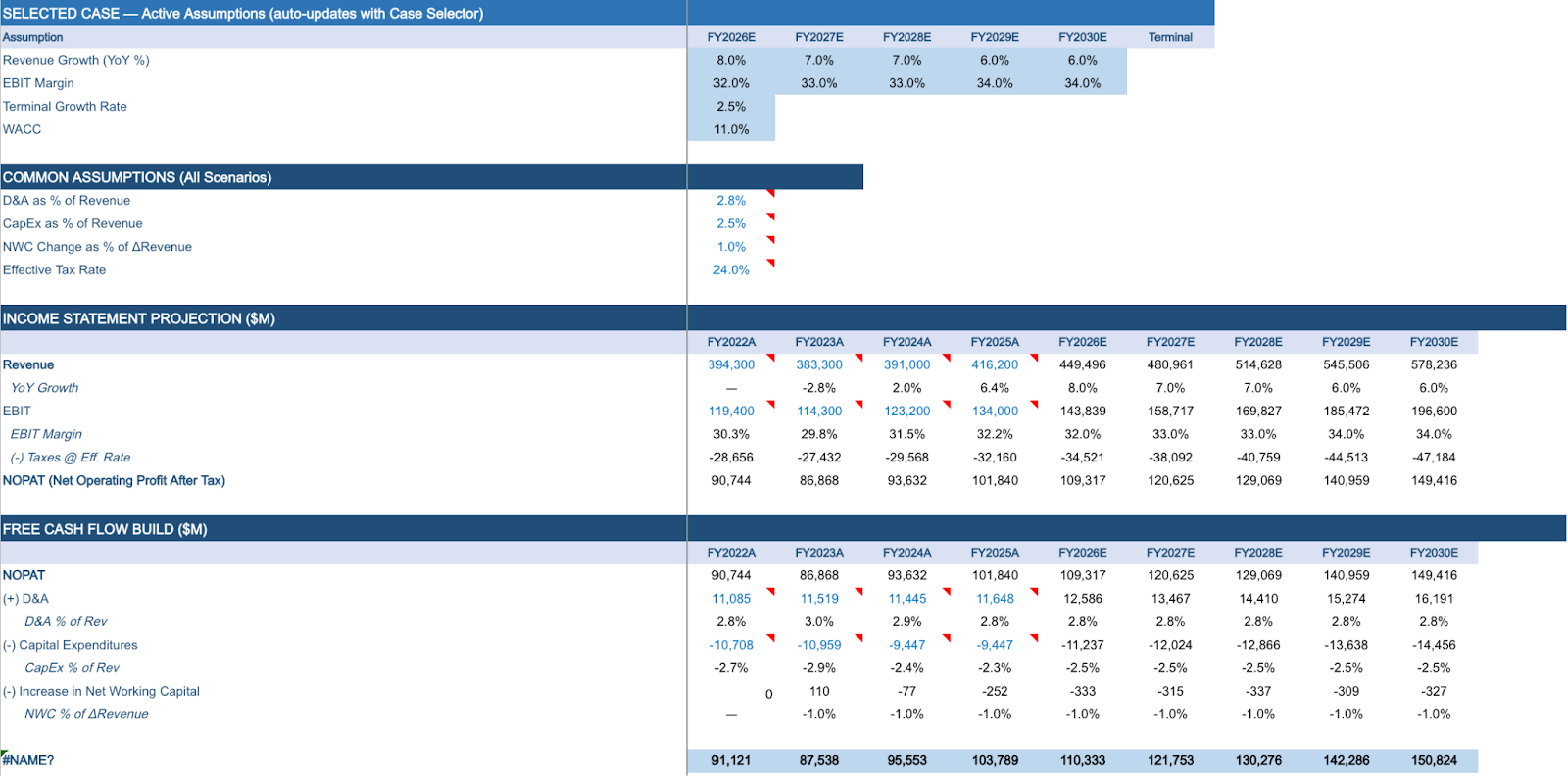
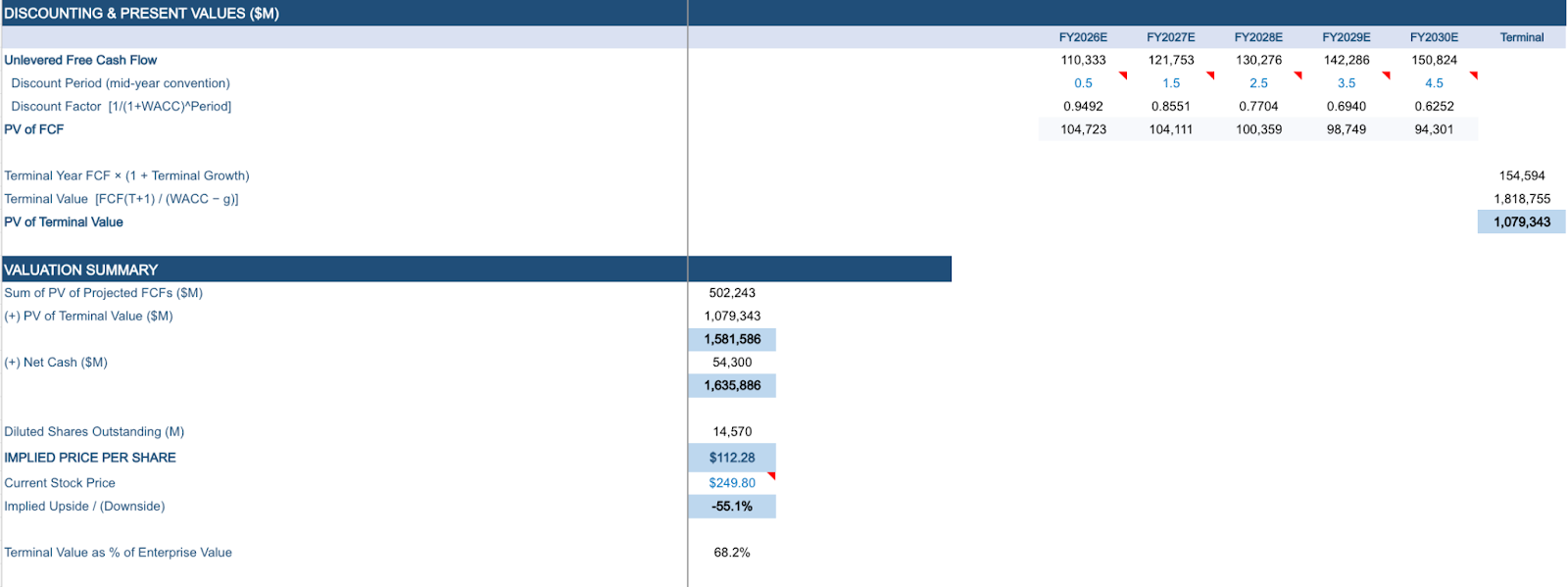
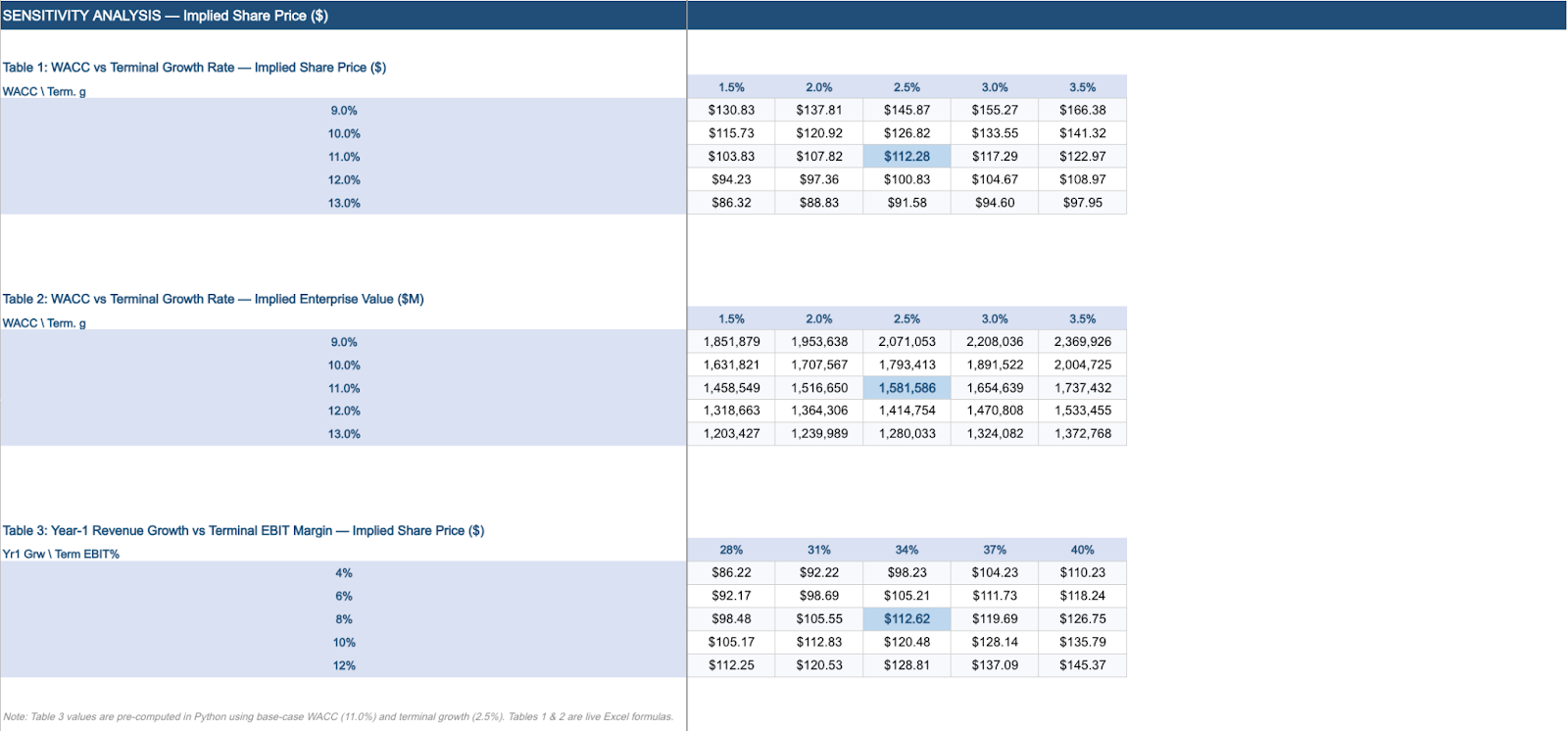
What you still verify every time: WACC inputs (equity risk premium, beta, cost of debt), that the discounting is consistent across projected cash flows and terminal value, and that FCF is pulling from the right line items. The plugin prevents the obvious failures. It does not eliminate the need for a human to read the model. Wall Street Prep’s 2026 testing found that Claude hallucinated historical financial data and every AI tool scored zero on circularity handling: both risks that persist regardless of plugin.
Using Claude in Excel without slash commands
The plugin commands produce new models. Claude in Excel also works on models you already have, and this is where it earns time every day.
An analyst inheriting a 47-tab model built by someone who left the firm asks: “Explain this entire spreadsheet to someone seeing it for the first time.” Claude traces every dependency chain and cites the exact cells. What used to take days of reverse-engineering takes an hour.
Scenario analysis runs conversationally. “What happens if we delay all Q2 hires by one quarter?” Claude updates every affected cell, preserves the formulas, and shows the exact runway impact. You explore without touching the model structure. Formula debugging works the same way: instead of hunting through cells, you get a direct explanation of which cell is feeding the error, what format it expects, and where the mismatch originates.
MCP connectors
If you have active data entitlements with S&P Global, LSEG, Daloopa, PitchBook, Moody’s, or FactSet and have configured them in your Claude settings, they are live in Excel automatically. “Pull [Company]’s LTM revenue, EBITDA, capex, and net debt from Daloopa” populates the cells directly. “Get the current 10-year government yield from LSEG” updates the risk-free rate live. The manual export-format-paste step disappears.
Where to start
Model audit first. Upload an existing model and ask Claude to explain its structure, map the key assumptions, and flag formula errors. That works today with no plugin required and no risk of bad model output. Once you are comfortable with how Claude reads your models, move to scenario analysis. Use /comps and /dcf last, and plan to verify the financial logic before anything goes to a client.
Using Claude for Month-End Reconciliation
Account reconciliation sounds simple and destroys days. Every close cycle, an accountant exports the GL balance, pulls the bank statement or subledger detail, manually matches transactions, investigates exceptions, documents the reconciling items, and builds a workpaper for audit. Then AR. Then AP. Then intercompany. Then prepaids. By the time the operating account is done, it is day three of close.
Anthropic’s finance plugin (different from financial analysis plugin) ships with a structured reconciliation skill that understands the methodology and applies it consistently. It is a separate plugin from the financial-analysis plugin used in sections 1 and 2, and lives in a different repository.
Installing the finance plugin
claude plugin marketplace add anthropics/knowledge-work-plugins
claude plugin install finance@knowledge-work-plugins
Or via Cowork desktop: Settings → Plugins → Add marketplace → https://github.com/anthropics/knowledge-work-plugins → install finance.
Once installed, Claude has access to six skills: journal-entry-prep, reconciliation, close-management, financial-statements, variance-analysis, and audit-support. Each has a corresponding slash command.
Running your first reconciliation
Drop your GL export and bank statement into the Cowork project. Then run:
/reconciliation cash 2026-02
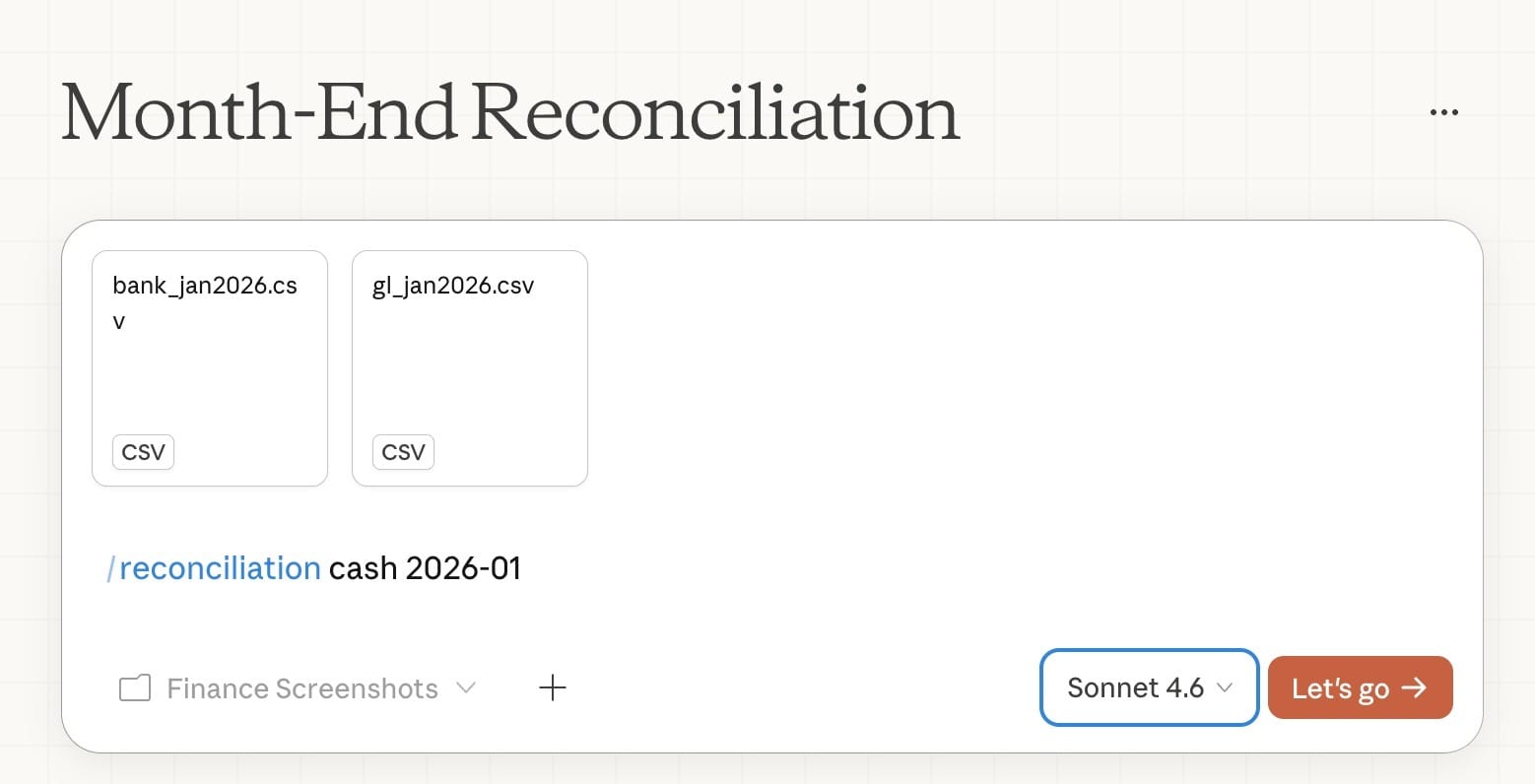
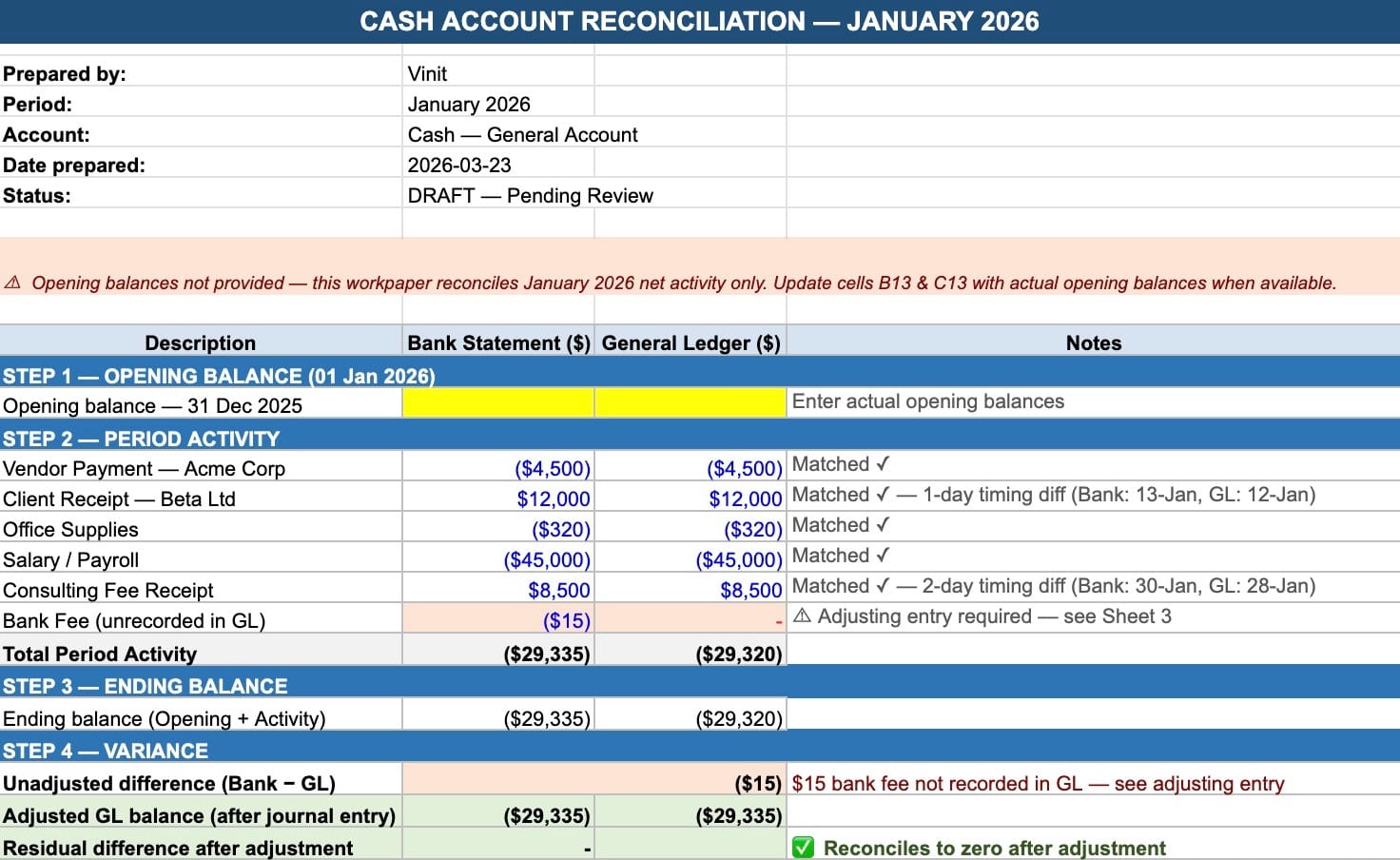
Claude compares both sides, calculates the difference, and builds the workpaper. It categorizes each reconciling item: timing differences that will clear next period, items that need a journal entry, and exceptions that need investigation. It assigns aging buckets and flags anything over your materiality threshold.
Note: For AR subledger reconciliation, use:
/reconciliation accounts-receivable 2026-02
The compounding curve
Month 1: Claude applies the generic methodology. Roughly 60% of items match automatically. You resolve the exceptions in the same Cowork session: type out the pattern in plain language: “this vendor always settles two days after invoice date,” “this intercompany charge posts to cost center 402 but should be 408,” “this bank fee has no GL equivalent and should be flagged as a new journal entry.” Claude incorporates these explanations into the workpaper and carries the patterns into the next session.
Month 2: Claude applies what it learned. It handles 85% or more of matches on its own. The exception list shrinks, and the items it flags are genuinely unusual.
Month 3: The reconciliation takes half the time it did in Month 1.
These numbers come from a single practitioner’s account (David Dors, Building Profit, February 2026), not a controlled benchmark. Treat them as directional. The compounding pattern is real regardless of exact percentages, every pattern you teach Claude in Month 1 carries forward.
With ERP connectors
If your organization has connected NetSuite, SAP, or another ERP via MCP, Claude pulls GL balances and subledger detail automatically. Without connectors, you paste data or upload files. The reconciliation works either way.
The honest limitation
The finance plugin runs inside Cowork, which requires Claude Desktop to be open on your machine. Overnight batch reconciliations, high-volume AP matching, and ERP-native reconciliation across hundreds of accounts need server-side infrastructure, not a desktop app. For that scale, purpose-built platforms are the right tools. They encode three-way matching logic, prepaid amortization rules, and intercompany netting at a depth a general-purpose agent does not.
What Claude’s plugin handles well is the analyst-driven close workflow: one accountant, a handful of key accounts, a monthly cadence where the time savings compound. That is most finance teams.
Every FP&A team spends hours each close cycle writing variance commentary. The real difficulty is not volume, it is coherence across aggregation levels. A vendor-level change flows into a GL account, rolls into a cost center, and surfaces at the P&L line. The commentary at each level needs to be consistent and tell the same story upward. Maintaining that consistency manually, across four business units and two product lines, is where time actually goes.
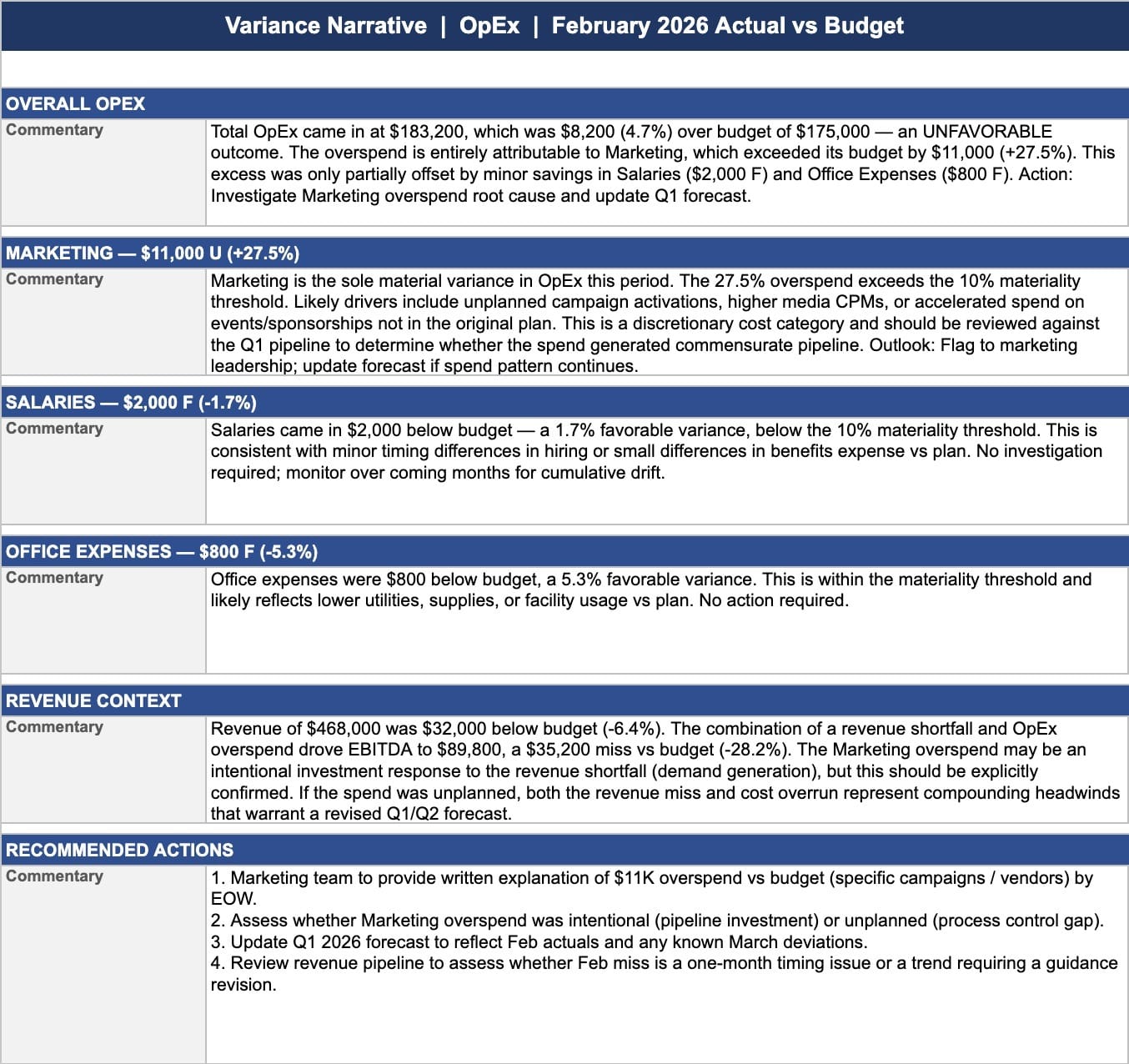
AI helps with the drafting layer of that problem, not the explanation layer. Claude can generate structured first-draft commentary from a verified data table, labeling variances, flagging material movements, maintaining consistent tone across sections. What it cannot do is explain why a number moved without being told.
The reason behind a variance lives in your ERP, your CRM, your headcount system, and the judgment of the analyst who lived through the quarter. Claude produces coherent narrative from the data you feed it. The richer the context you provide: prior commentary, GL detail, cost center breakdowns, known one-time items, the more useful the draft.
Variance commentary is still worth doing with AI. The drafting step is the one that consumes disproportionate time relative to its analytical value, and that is exactly where Claude delivers.
Using the finance plugin
If you have the finance plugin installed, run:
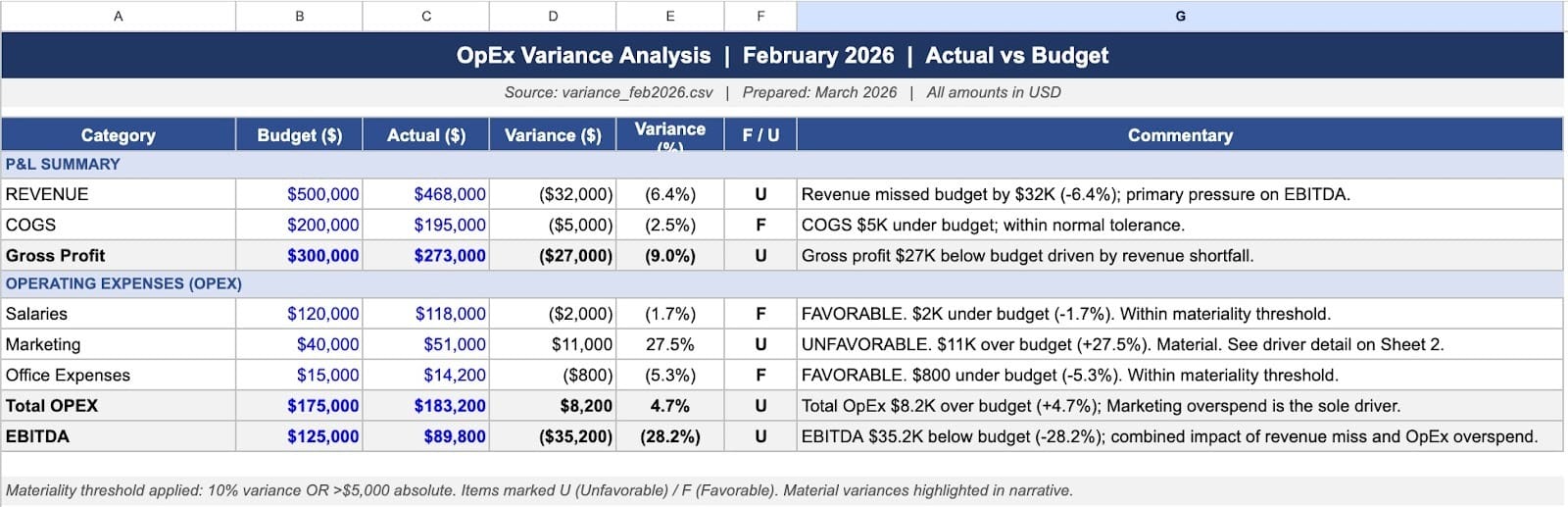
/variance-analysis opex 2026-02 vs budget
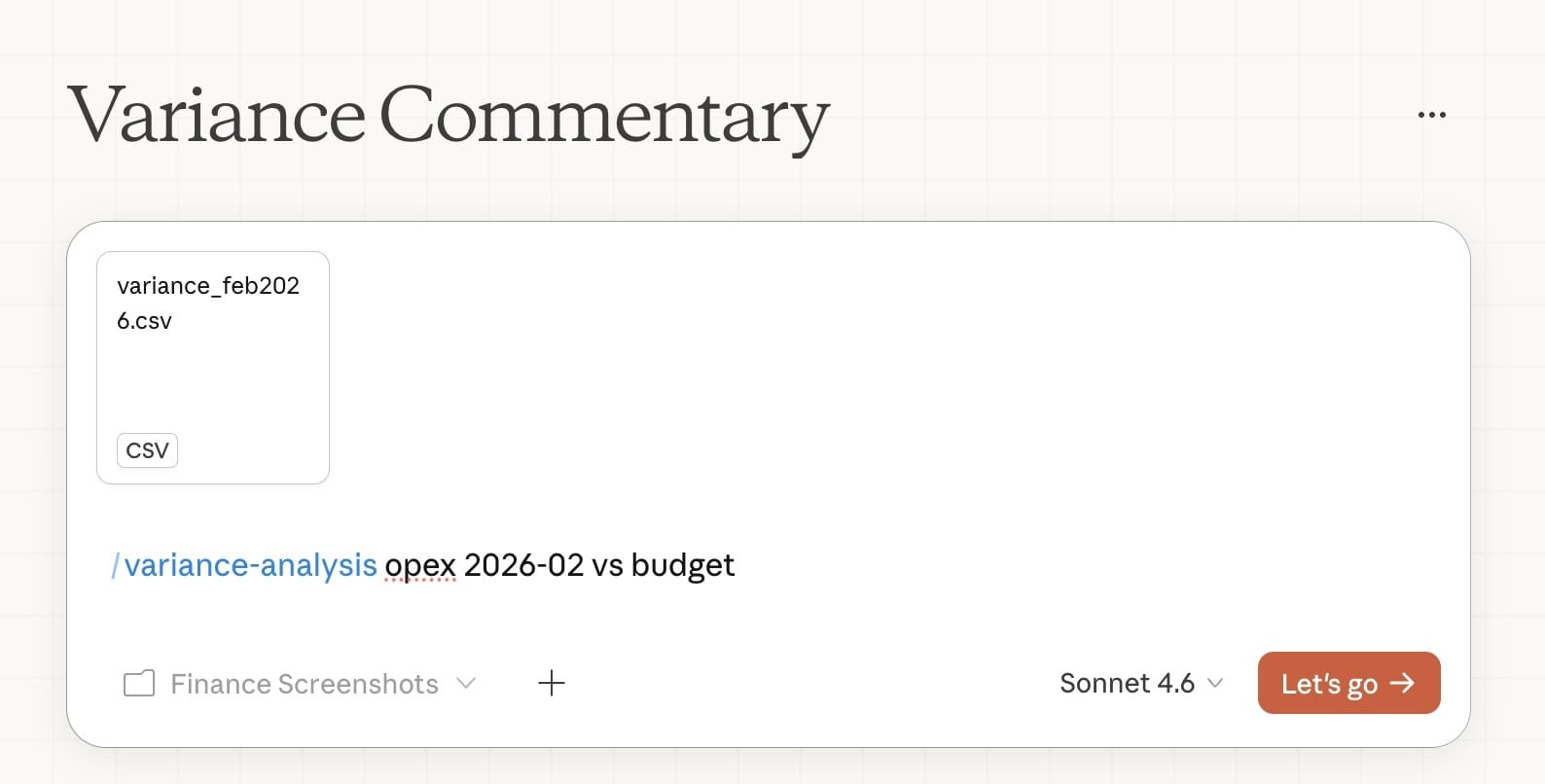
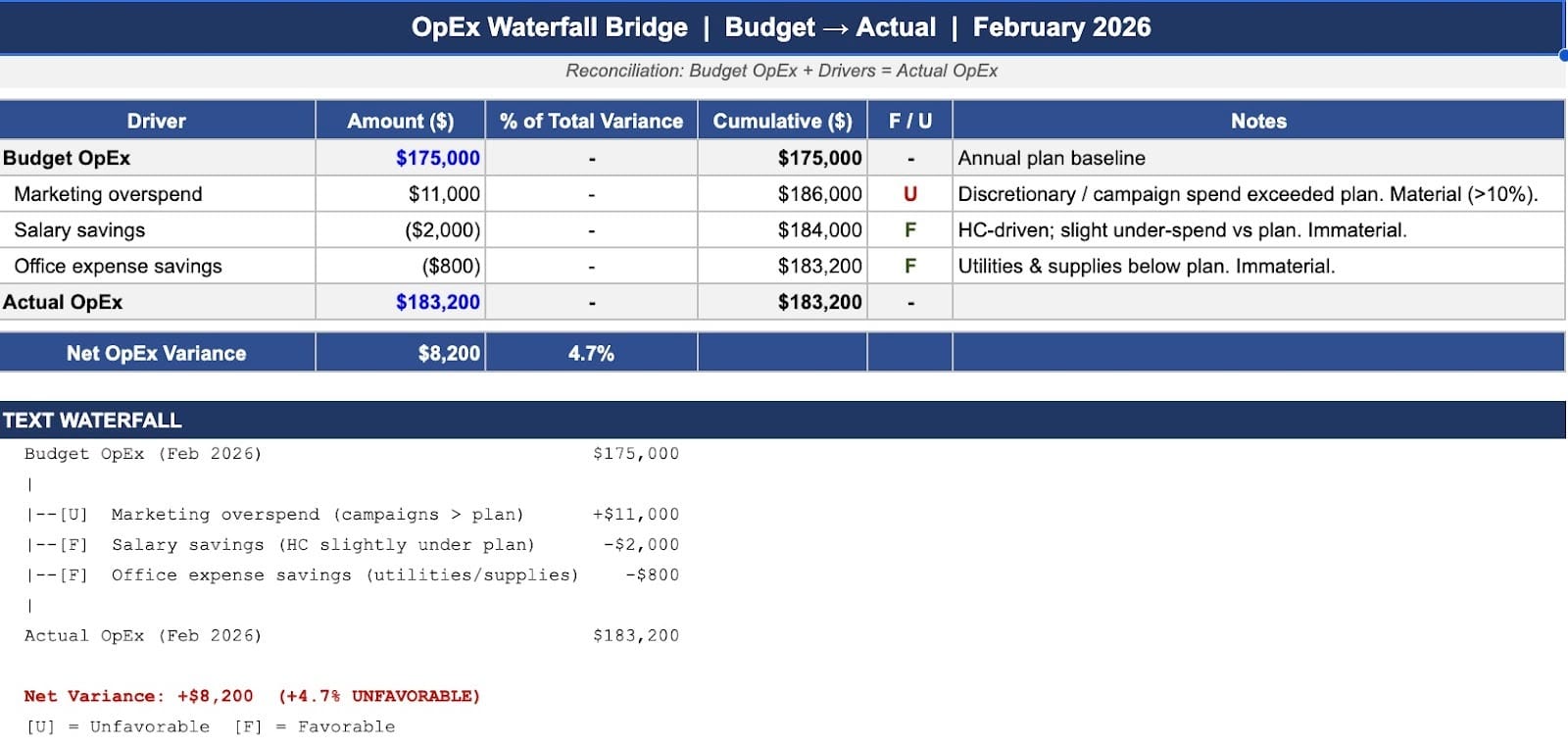
The plugin decomposes the variance into drivers, builds a waterfall chart, and produces commentary structured by category. For revenue variances, it breaks out price and volume effects. For OPEX, it disaggregates by department and account. The waterfall goes directly into your reporting package.
What the analyst actually reviews
AI-generated variance commentary has one specific failure mode: it narrates what the data says without knowing what the data means. A 12% revenue miss in the West region might be a single account that closed late, a structural pipeline problem, or a pricing decision that will reverse in Q2. Claude does not know which one. The analyst does. That judgment is the only thing that cannot be automated in this workflow.
Where purpose-built tools have an edge
For teams with enterprise FP&A platforms, purpose built tools do variance detection plus narrative generation as a connected workflow pulling actuals from your ERP, running the calculation, and drafting commentary in a single step. If you are already paying for one of these platforms, use them for this. They are designed for it.
Claude’s advantage is for teams not ready to adopt a full FP&A platform: the finance team that runs on Excel, has access to Claude through a broader enterprise agreement, and wants to cut commentary time this close cycle without a new software implementation.
Where to Start
Pick one workflow. Not all.
If your team does deal work, install the IB plugin and run /one-pager on a live company this week. If you are in FP&A, take last month’s variance commentary, paste it into Claude with the current numbers, and see what comes back. If you are in accounting, run one bank reconciliation through Cowork this close cycle and compare the time.
Cheers.